
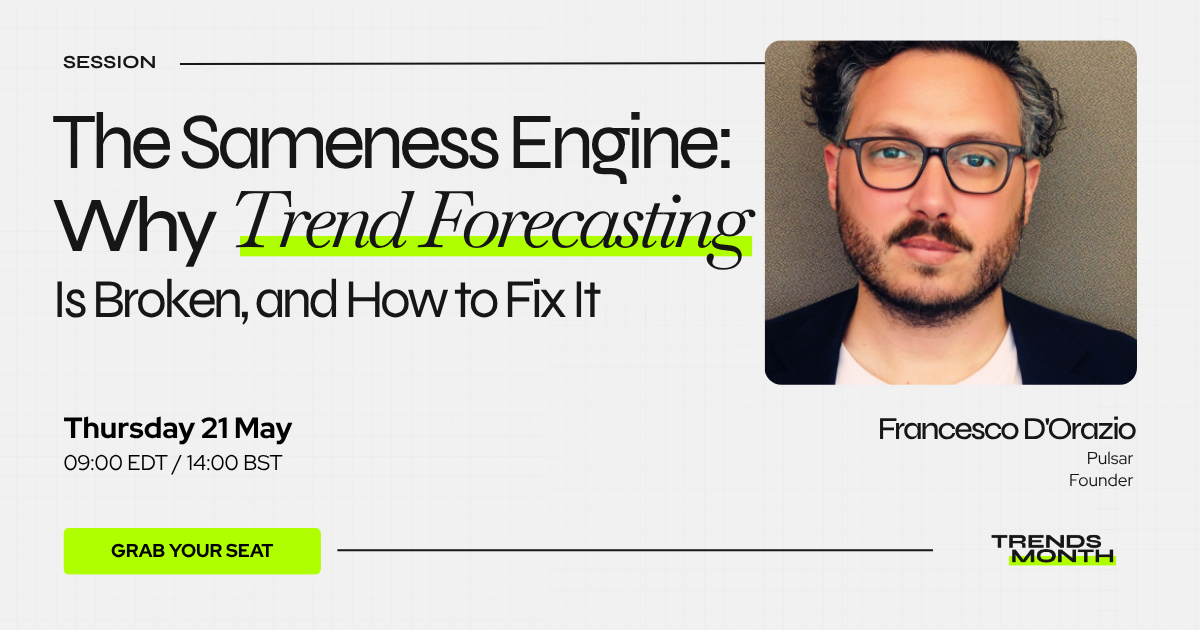
The Sameness Engine: Why Trend Forecasting Is Broken, and How to Fix It
%20(1).jpeg)
For a decade, brands have chased the same lagging indicators, like sales data, search volumes, retail analytics, social virality — and ended up looking identical. Big data tells you what everyone else already knows. By definition, it’s a sameness engine. And the obvious AI shortcut makes it worse: large language models are trained on the rear-view mirror and statistically revert to the mean, which is the opposite of where real trends live.
This session lays out a different approach, built on the scientific method: detect with big data, validate with thick data, test with synthetic data. The deeper change is one of mentality. Trends should be treated as hypotheses to test, not statistical events to report. “Cozy cardio is trending” is a headline. “Consumers are reframing fitness as recovery and self-soothing” is a hypothesis. Only one of those things is useful.
We’ll work through three examples that share one underlying mood. The collapse of personal agency in a system that no longer feels controllable. Cowboy culture read not as heritage nostalgia but as a cry for stability and control. The lottery economy, including Kalshi, Polymarket, crypto-as-wealth-strategy, as the financial expression of the same mood. And GLP-1s reframed from weight-loss trend to “wanting less” trend, with users simultaneously drinking less, gambling less, and doomscrolling less. Three surface signals, one macro-mood, and three strategic conclusions counting tools will never surface on their own.
The argument is honest about its own limits. The methodology doesn’t escape sameness automatically. It creates the space in which differentiation becomes possible. The variance comes from human judgment, the willingness to commit to falsifiable readings, and the cadence to act before consensus. The methodology is the floor; what teams build on top of it is the ceiling.
This session is for insight leaders, strategists, and foresight teams who want to move beyond trend reporting and build a more rigorous way of understanding what’s actually changing.
By the end of the session, you’ll:
- Understand why current trend approaches converge into a sameness engine
- Apply the detect / validate / test framework to your own trend process
- Move from descriptive reporting to hypothesis testing as the unit of trend analysis
- Distinguish a viral signal from a meaningful cultural shift using a thick-data interpretive layer
- Connect superficially unrelated signals to a shared socio-economic mood
- Make a defensible call on where synthetic personas earn their keep — and where they don’t
This interview was recorded via LinkedIn Live, if you prefer to view on LinkedIn, click the button below.
View Interview